I've been trying to decide what to write first about Japan. We saw several different aspects of this interesting country, so I'm going to start with the most unusual part of the trip - our visit to the islands in the Seto Inland Sea. And of the three islands we saw there, I think Teshima was the strangest. (Click here to see where Teshima is.)
In fact, there was so much to see on Teshima that I'm going to divide my post into two parts. Otherwise, like me, you might end up with a spinning head.
So, let me give you some brief background. (VERY brief - I apologise if you're an expert and know how much I'm leaving out!)
Like much of rural Japan, the Seto Sea islands are depopulated and poor, in great contrast to the ultra-modern cities and famous tourist areas. The area, though, is one of great natural beauty. Some years ago, a wealthy man, CEO of the major Japanese company of Benesse Co, hired top architects to create some remarkable buildings on the Seto Sea island of Naoshima. They included a unique underground gallery (by Tadao Ando) which houses both his collection of Monets and some very large art installations, like the huge room below, which is created with, among other things, pure gold leaf.

Over following years, more buildings and artworks were commissioned. Eventually the Setouchi Triennale festival was founded to bring more art to more islands, with the focus switching to giving these islands a new life. Major artists have created work that reflects the life and history of these forgotten places. Several have taken over existing derelict buildings and turned them into artworks, but there is no predicting what they will do. Some of the work is temporary, but much of it is permanent, so you can visit them at any time of year.
You need weeks if not months to see everything, but we were lucky to catch the last few days of the 2016 Triennale. We started our trip from the port town of Takamatsu, and I hope the picture below captures that exciting feeling of waiting at a ferry on a bright, sunny morning, heading for somewhere new. There's our boat approaching. - a high speed launch called ARTBOAT.


We were greeted by Kureishi, our Airbnb host. Airbnb, in case you don't know, is a site where private individuals are supposed to rent out holiday accommodation. I haven't always been that thrilled with it, but Kureishi was just the kind of host everyone hopes to get. He was so friendly, kind and fun, and he really wanted us to get the best from our trip.
He took us to one of the art houses just round the corner from the port. It was created from an old house by German sculptor Tobias Rehberger. * It overlooks the sea and appears pretty ordinary from the outside...


The stripes gave way to spots on the stairs.....


I did consider retreating into the restroom to give my eyes a break. But I soon changed my mind when I saw ever more abstract versions of myself repeating into infinity....

You can see more about this house, including fascinating photo notes of how it was transformed from a ruined wreck, if you go here.
It was a bright sunny day, and, seeking "Storm House," we wandered around that satsuma orchard I mentioned in the last post ...

....and past hillside shrines...

....and wild flowers growing from rocks...

and found Storm House, to all appearances a small, wooden, and rather shabby Japanese house.
As you enter, the temperature drops and you gradually experience just how it would be to endure a severe thunderstorm storm in this house, with the electricity flickering and then dying, the rain hammering on the roof and water dripping through into buckets on the floor.
It's quite eerie, although (as with all installations, you have to be there to experience it). The followings video gives you a faint idea of that experience, but what it doesn't show is the shock of stepping from cold and dark and rain and noise into calmness and sunshine again afterwards.
But, as I said, it wasn't all art houses by any means. Still, I'm going to end this post here, and post Part 2 soon.
*PS The house's name is "Was du liebst, bring dich aus zum weinen" - "What you love makes you cry." I'd thought it was "Il Vente" ("The Wind") but that is just the name of the cafe. Thanks to David Billa for pointing this out. David's amazing blog "Setouchi Explorer" helped get me interested in the Seto Sea artworks, and I link to this in Part 2 - but hey, I'll do it now, too.
In fact, there was so much to see on Teshima that I'm going to divide my post into two parts. Otherwise, like me, you might end up with a spinning head.
So, let me give you some brief background. (VERY brief - I apologise if you're an expert and know how much I'm leaving out!)
Like much of rural Japan, the Seto Sea islands are depopulated and poor, in great contrast to the ultra-modern cities and famous tourist areas. The area, though, is one of great natural beauty. Some years ago, a wealthy man, CEO of the major Japanese company of Benesse Co, hired top architects to create some remarkable buildings on the Seto Sea island of Naoshima. They included a unique underground gallery (by Tadao Ando) which houses both his collection of Monets and some very large art installations, like the huge room below, which is created with, among other things, pure gold leaf.

You need weeks if not months to see everything, but we were lucky to catch the last few days of the 2016 Triennale. We started our trip from the port town of Takamatsu, and I hope the picture below captures that exciting feeling of waiting at a ferry on a bright, sunny morning, heading for somewhere new. There's our boat approaching. - a high speed launch called ARTBOAT.

Once we were aboard, it roared off, spray glittering in its wake. It was exciting and beautiful - though I noticed that at least two young passengers weren't enjoying it much...

And soon we saw Ieura port, on Teshima.

He took us to one of the art houses just round the corner from the port. It was created from an old house by German sculptor Tobias Rehberger. * It overlooks the sea and appears pretty ordinary from the outside...

When you enter, you must remove your shoes and put on slippers, as is normal in Japan, and you pay a few hundred yen at the desk.

Inside, the structure of the house is completely normal, except that it is painted with dazzling optical effects to trick the eye.


Here's the cafe, (which was closed at the time)
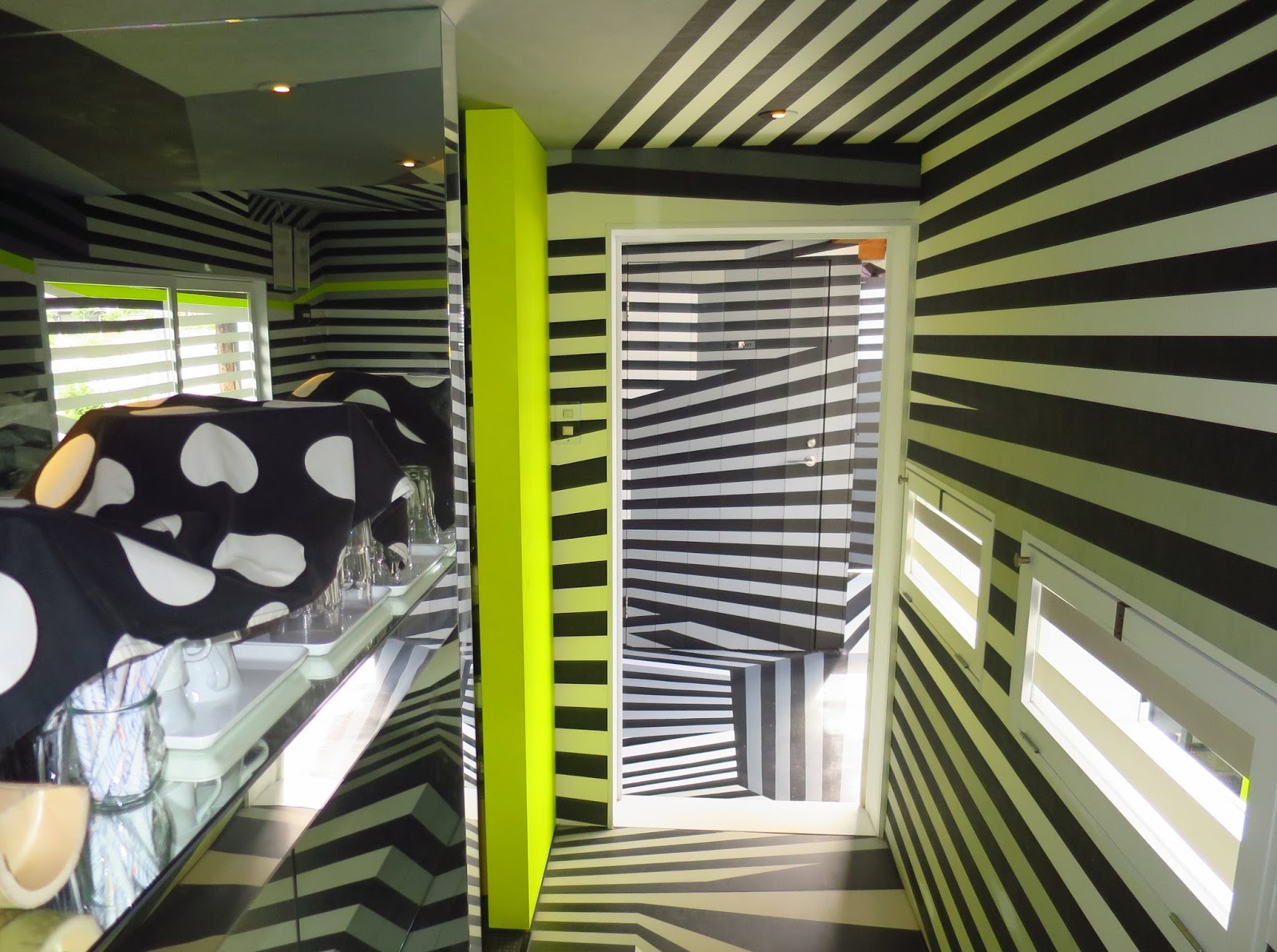
I can't help wondering what food they offered when it was open. Liquorice allsorts, perhaps?

A narrow staircase leads to the upper floor

The stripes gave way to spots on the stairs.....

Reminds me a bit of the Sea of Holes in the film "The Yellow Submarine."

You can see the fishing boats through the window, and the roofs of neighbouring houses.

So that was enough to make the head spin, but just round the corner, we discovered the Yokoo House, which was equally eye catching. This was created by the Japanese architectural practice of Yuko Nagayama & Associates. We weren't allowed to take many pictures inside, but this is how Yokoo House reflects the outside world.

I don't know how it's done but this is how it looks when you step inside the door.

The house features a traditional Japanese garden in bright and unexpected colour. Carp, symbols of good luck, swim on the mosaic stream-bed through the garden and right under the house, which has both a glass floor and a glass ceiling.

I liked standing inside and watching the carp swimming under the floor.

The house contains many rather startling paintings which we weren't allowed to photograph. Actually, though, I thought the changing visual effects were more interesting than the paintings.

I did consider retreating into the restroom to give my eyes a break. But I soon changed my mind when I saw ever more abstract versions of myself repeating into infinity....

You can see more about this house, including fascinating photo notes of how it was transformed from a ruined wreck, if you go here.
Kurieshi drove us back to his house to leave our bags, and then we took a bus to the Karato Oka area, to see "Storm House." The artists were George Bures Miller and Janet Cardiff. She's essentially a sound artist so you really have to experience her work first-hand, but I've wanted to know more about her since experiencing her "40 Part Motet" a few years ago.
It was a bright sunny day, and, seeking "Storm House," we wandered around that satsuma orchard I mentioned in the last post ...

....and past hillside shrines...

....and wild flowers growing from rocks...

and found Storm House, to all appearances a small, wooden, and rather shabby Japanese house.
As you enter, the temperature drops and you gradually experience just how it would be to endure a severe thunderstorm storm in this house, with the electricity flickering and then dying, the rain hammering on the roof and water dripping through into buckets on the floor.
It's quite eerie, although (as with all installations, you have to be there to experience it). The followings video gives you a faint idea of that experience, but what it doesn't show is the shock of stepping from cold and dark and rain and noise into calmness and sunshine again afterwards.
But, as I said, it wasn't all art houses by any means. Still, I'm going to end this post here, and post Part 2 soon.
*PS The house's name is "Was du liebst, bring dich aus zum weinen" - "What you love makes you cry." I'd thought it was "Il Vente" ("The Wind") but that is just the name of the cafe. Thanks to David Billa for pointing this out. David's amazing blog "Setouchi Explorer" helped get me interested in the Seto Sea artworks, and I link to this in Part 2 - but hey, I'll do it now, too.

