Showing posts with label Japan. Show all posts

Saturday, 25 March 2017

At Last!

At last!!!  I have managed to change the colours on my blog to make it more readable.  Long story about a fault on Blogger - but anyway, I hope those of you who were dazzled by the previous lurid colour scheme find it easier now. 

Here in London our thoughts are with the victims of the Westminster attack, but London has survived so much over the years, and I do remember when life was overlaid with the constant threat of IRA bombs some years ago.  So things are carrying on exactly as usual, but I suppose the risk of trouble is always at the back of peoples' minds, as it is, sadly, in so many places in the world. 

  I've hardly been at the computer at all, so I am sorry that I've been remiss about responding to comments.  I do read and appreciate them very much, so I'll aim to do better in future.  I'm now posting more Japanese pictures, though, since there are still loads of things I would like to tell you about.   So here is something about Miyajima island, near Hiroshima. It's particularly famous for its large orange Torii gate which stands in the shallow sea just offshore.    


At low tide you can get very close to the gate as you see in the photos above and below.  It's exhilarating, if a bit soggy, to walk over the sands.  I noticed the old gent below walking out with his pet dog  - or at least, he was walking and the dog was sitting in its buggy.


This big torii gate marks the entrance to the Itsukushima Shinto shrine complex. ("Itsukushima" is another name for the island).  It is famous for several reasons, mainly that the main shrine as well as the torii seem to be rising from or floating on the water. And, as you see below, the general appearance of the place also reflects traditional Japanese ideas about landscape beauty, with sea, mountains and architecture in relation to each other.  It really is wonderful. 


The shrine's present design dates from the 12th century, even though it had been a holy place for six centuries before that. So pure was it that for many years no births and deaths were allowed to take place there.  (If someone died suddenly I suppose there would have been great consternation - nobody was able to tell me if this had ever happened though. I probably shouldn't have asked!)
  

The site is large so didn't seem crowded, and October weather in Hiroshima is generally good so the general atmosphere was peaceful and pleasant. It's a working shrine and ceremonies were going on in the normal way - in fact there were lots of monks around. Here's one explaining to some schoolgirls about this section of a huge and very old tree.   (T and I have been racking our brains to remember the exact significance of this gnarled and ancient slice of wood, so perhaps one Japanese speaking reader might click on the picture and enlarge it enough to read the notice on it?)


A couple of years ago I visited beautiful Nara park and admired the deer, so was charmed to find that semi wild deer roam the temple grounds here, too, and they are not backward in their search for food from tourists.  These people were having some trouble posing for their group photo while deer enthusiastically rummaged in their bags for food.


I like to look for little details, so this home made tableau caught my eye, arranged on a box in the street.  I wondered about the meaning (if any) of the pine cone in the foreground,which, as you see, has a long stalk balanced across it, with an acorn at each end.


High up on the hillside is Senjokaku hall, a monumental part of the shrine complex. It's as large as "1000 tatami mats"  (which are, I'm told 85.5 x 179 cm each - that's about 33.5 x 70.5 inches. Tatami mats are used in Japan as a way of indicating the size of a space).  Attached to the massive roof beams are votive paintings, and in the background you might spot huge rice spoons propped up on the floor, nearly twice the height of a man. They're called shamoji, they have some religious significance and are particularly associated with the island of Miyajima.


Similar flat rice spoons have become one of Miyajima's best selling souvenirs - needless to say the souvenir spoons are much smaller than the ones above.  Little cakes shaped like maple leaves are also widely sold on the island.... here's one which formed part of our picnic lunch, together with sandwiches beautifully packed by the friend we were staying with. (It looks so much more elegant than my rough old version of a picnic....)


Anyway,  Senjokaku has a fabulous view from all sides, as you see below. A quiet and peaceful place to sit and contemplate, with only the sound of birds to be heard and the sun coming in.


In this distant view you can see how large the hall is; it's just to the left of the pagoda.  


Despite the island's fame, the tourism isn't too high key, and we particularly enjoyed the town museum, which spreads over several rooms in an old house.  Of everything there, I was specially impressed by the prints on display. Japanese printmaking is most famous in the West for the work of a small handful of artists, of which Hiroshige and Hokusai are the best known. But in fact it is a huge art form with many celebrated artists and it's an absolute delight to look at the variety of it all. This woodcut in Miyajima museum appealed very much to me.  I recognised the shrine, but I didn't understand what was going on.  T is learning Japanese but his reading isn't up to deciphering the label. 


It looks immensely dramatic, anyhow.  

I'm looking forward to the Hokusai exhibition at the British Museum but how I wish there would be a more comprehensive exhibition of Japanese printmaking.  Like most Westerners, I had absolutely no idea of how wonderful it is.

Monday, 12 December 2016

Folklore and Fish

Normally I'd be talking about Christmas, but I've been stuck inside with a nasty bug. Inside my head I've been returning to Akita though, in Northern Japan, so let me introduce you to the Namahage, the region's most famous folkloric characters. 

 The Oga peninsula has lots of thick forest and lovely coastline, and driving along the remote little road we suddenly came across these two giving us a friendly wave...


Well, maybe not that friendly.

Akita Prefecture is famous for its Namahage.  Or Yamahage (see later). Our friends were taking us to a museum deep in the forest, part of which is a traditional inn (below), where it's a good idea to begin your visit.


Once inside the inn, you need to imagine it's New Year and the landscape outside is deep in snow. There is nobody for miles, except..... the Namahage.  These are demonic religious figures whose job it is to make sure that people (especially the children) are working hard, being tough and enduring difficult things.  They dress in straw, have long hair and terrifying masks. 

They arrive outside the house roaring and shouting and banging at the door, upon which they must be invited in.  Once inside, they stamp about (stamping is often a way of getting rid of evil).  Then they shout at the children, demanding to see their lesson books, and fire questions around about how good everyone is being.  You see the one below shaking his finger.  


When everything is in uproar, and the children are screaming their heads off, the Namahage are offered food, drink and sake ("Kampai!" or "cheers!" - see below).  Then they go away, leaving everyone to reflect on whether or not they have been quite hardworking and strong enough lately.


I guess the tradition wouldn't get the approval of supernanny Jo Frost, though Mary Poppins might have had a shade of sympathy .... but anyway, that's what they do. Near the inn, there's a really beautiful museum giving a lot of background to this curious tradition and


also offering you the chance to dress up as a namahage yourself, in rice straw cape and shoes. Sorry it's a bit blurry, I wasn't using flash.


And when fully dressed you might look a bit like this....


Here is T. trying on a mask for size. 


and local kids had done some terrific, and terrifying murals, although, as you see the kid in the green sweater at the bottom of the picture is obviously finding the whole thing really amusing...  there's always one, isn't there?


In fact, the Namahage are the popular face of another very similar tradition, the Yamahage. Confusingly, the Yamahage, although they look and act in a similar way,  are much more rustic and are not a tourist attraction, and are more associated with having a good rice harvest.   As in many parts of rural Japan, though, the young are fleeing to Tokyo and other big cities, and the private old religious customs are struggling to survive in their pure and original form. So the Yamahage, with their simple rice straw masks are falling foul of the plain fact that you need to be young and quite serious about the rice harvest to tramp around for hours through sub-zero winter woods while dressed in straw.  It is as well that the Namahage are keeping their traditions alive.

Anyway, there are religious roots to both Namahage and Yamahage, as you can see from zigzag white streamers the creatures carry (below and first picture). 


I would love to go into this in more detail but I don't want this post to be full of my rather half-baked thoughts on Japanese folklore, so I'll just say that I bought the twins some splendid Namahage socks in the fantastic gift shop. I was also a bit tempted by this keyring of Jibanyan, "Yokai Watch"'s fire raising cat, as a Namahage.   Don't you think it's cute?


By the time we'd seen the museum it was gone lunchtime, so we drove a little further on to a fish restaurant our friends knew. We would never have found this on our own. It's a simple place, with plastic tables and a couple of Japanese style low tables, and all over the walls are pictures of the owners and their friends.  Basically they get fish from the sea each day, chop it up and cook it with vegetables in a wooden dish containing red hot stones.  It is really, really delicious, and, as always in Japan, beautifully presented with many side dishes.


The owners were so cheerful and friendly, chatting and joking with their customers. They posed for their picture.


And since we were their very last lunch customers of the day, they came out and waved us goodbye when we left, also bowing as is the Japanese custom.


We drove back via some wild, windy and unspoiled coastal scenery. By now the sun was starting to appear.  I could have stayed for far longer and taken a walk by the sea...


But we had to get back to collect our friend's son from school!


Friday, 25 November 2016

Teshima, Part 1

I've been trying to decide what to write first about Japan.  We saw several different aspects of this interesting country, so I'm going to start with the most unusual part of the trip - our visit to the islands in the Seto Inland Sea.  And of the three islands we saw there, I think Teshima was the strangest. (Click here to see where Teshima is.)

In fact, there was so much to see on Teshima that I'm going to divide my post into two parts. Otherwise, like me, you might end up with a spinning head.

So, let me give you some brief background. (VERY brief - I apologise if you're an expert and know how much I'm leaving out!)

Like much of rural Japan, the Seto Sea islands are depopulated and poor, in great contrast to the ultra-modern cities and famous tourist areas.  The area, though, is one of great natural beauty.  Some years ago, a wealthy man, CEO of the major Japanese company of Benesse Co, hired top architects to create some remarkable buildings on the Seto Sea island of Naoshima. They included a unique underground gallery (by Tadao Ando) which houses both his collection of Monets and some very large art installations, like the huge room below, which is created with, among other things, pure gold leaf. 


Over following years, more buildings and artworks were commissioned.  Eventually the Setouchi Triennale festival was founded to bring more art to more islands, with the focus switching to giving these islands a new life.  Major artists have created work that reflects the life and history of these forgotten places. Several have taken over existing derelict buildings and turned them into artworks, but there is no predicting what they will do. Some of the work is temporary, but much of it is permanent, so you can visit them at any time of year. 

You need weeks if not months to see everything, but we were lucky to catch the last few days of the 2016 Triennale. We started our trip from the port town of Takamatsu, and I hope the picture below captures that exciting feeling of waiting at a ferry on a bright, sunny morning, heading for somewhere new.  There's our boat approaching. - a high speed launch called ARTBOAT.

Once we were aboard, it roared off, spray glittering in its wake.  It was exciting and beautiful - though I noticed that at least two young passengers weren't enjoying it much... 


And soon we saw Ieura port, on Teshima.  


We were greeted by Kureishi, our Airbnb host.  Airbnb, in case you don't know, is a site where private individuals are supposed to rent out holiday accommodation. I haven't always been that thrilled with it, but Kureishi was just the kind of host everyone hopes to get.  He was so friendly, kind and fun, and he really wanted us to get the best from our trip.

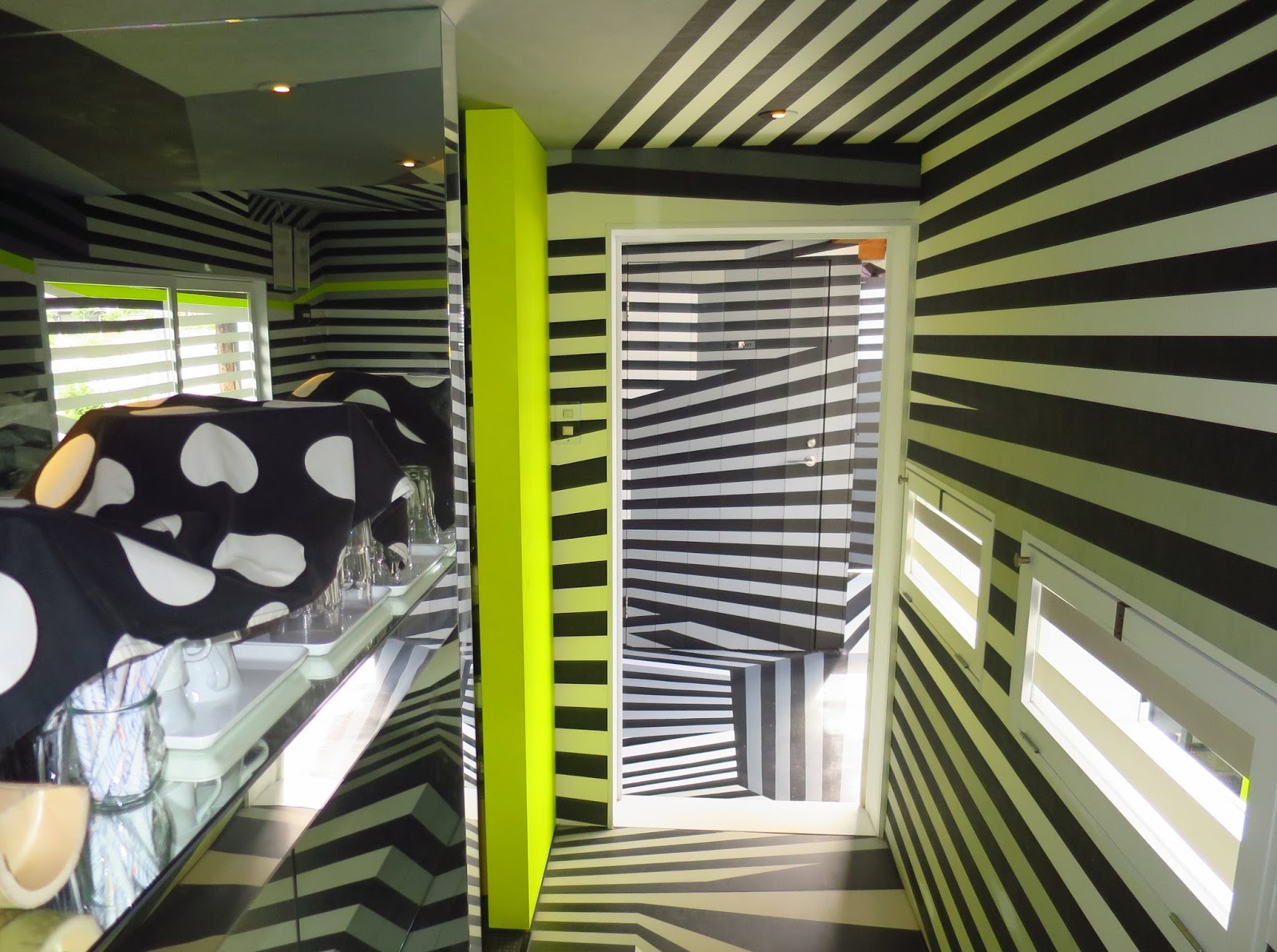
He took us to one of the art houses just round the corner from the port.   It was created from an old house by German sculptor Tobias Rehberger. * It overlooks the sea and appears pretty ordinary from the outside...


When you enter, you must remove your shoes and put on slippers, as is normal in Japan, and you pay a few hundred yen at the desk.


Inside, the structure of the house is completely normal, except that it is painted with dazzling optical effects to trick the eye.  


Here's the cafe, (which was closed at the time)


I can't help wondering what food they offered when it was open. Liquorice allsorts, perhaps? 


A narrow staircase leads to the upper floor


The stripes gave way to spots on the stairs.....


Reminds me a bit of the Sea of Holes in the film "The Yellow Submarine."


You can see the fishing boats through the window, and the roofs of neighbouring houses.


So that was enough to make the head spin, but just round the corner, we discovered the Yokoo House, which was equally eye catching.   This was created by the Japanese architectural practice of Yuko Nagayama & Associates. We weren't allowed to take many pictures inside, but this is how Yokoo House reflects the outside world.  


I don't know how it's done but this is how it looks when you step inside the door.  


The house features a traditional Japanese garden in bright and unexpected colour. Carp, symbols of good luck, swim on the mosaic stream-bed through the garden and right under the house, which has both a glass floor and a glass ceiling. 


I liked standing inside and watching the carp swimming under the floor. 


The house contains many rather startling paintings which we weren't allowed to photograph. Actually, though, I thought the changing visual effects were more interesting than the paintings.  


I did consider retreating into the restroom to give my eyes a break. But I soon changed my mind when I saw ever more abstract versions of myself repeating into infinity....


You can see more about this house, including fascinating photo notes of how it was transformed from a ruined wreck, if you go here.

Kurieshi drove us back to his house to leave our bags, and then we took a bus to the Karato Oka area, to see "Storm House."  The artists were George Bures Miller and Janet Cardiff. She's essentially a sound artist so you really have to experience her work first-hand, but I've wanted to know more about her since experiencing her "40 Part Motet" a few years ago. 

It was a bright sunny day, and, seeking "Storm House," we wandered around that satsuma orchard I mentioned in the last post ...


....and past hillside shrines...


....and wild flowers growing from rocks...


and found Storm House, to all appearances a small, wooden, and rather shabby Japanese house.

As you enter, the temperature drops and you gradually experience just how it would be to endure a severe thunderstorm storm in this house, with the electricity flickering and then dying, the rain hammering on the roof and water dripping through into buckets on the floor.

It's quite eerie, although (as with all installations, you have to be there to experience it). The followings video gives you a faint idea of that experience, but what it doesn't show is the shock of stepping from cold and dark and rain and noise into calmness and sunshine again afterwards.


But, as I said, it wasn't all art houses by any means.   Still, I'm going to end this post here, and post Part 2 soon.

*PS The house's name is "Was du liebst, bring dich aus zum weinen" - "What you love makes you cry."  I'd thought it was "Il Vente" ("The Wind") but that is just the name of the cafe.   Thanks to David Billa for pointing this out. David's amazing blog "Setouchi Explorer" helped get me interested in the Seto Sea artworks, and I link to this in Part 2 - but hey, I'll do it now, too. 


Blog Archive