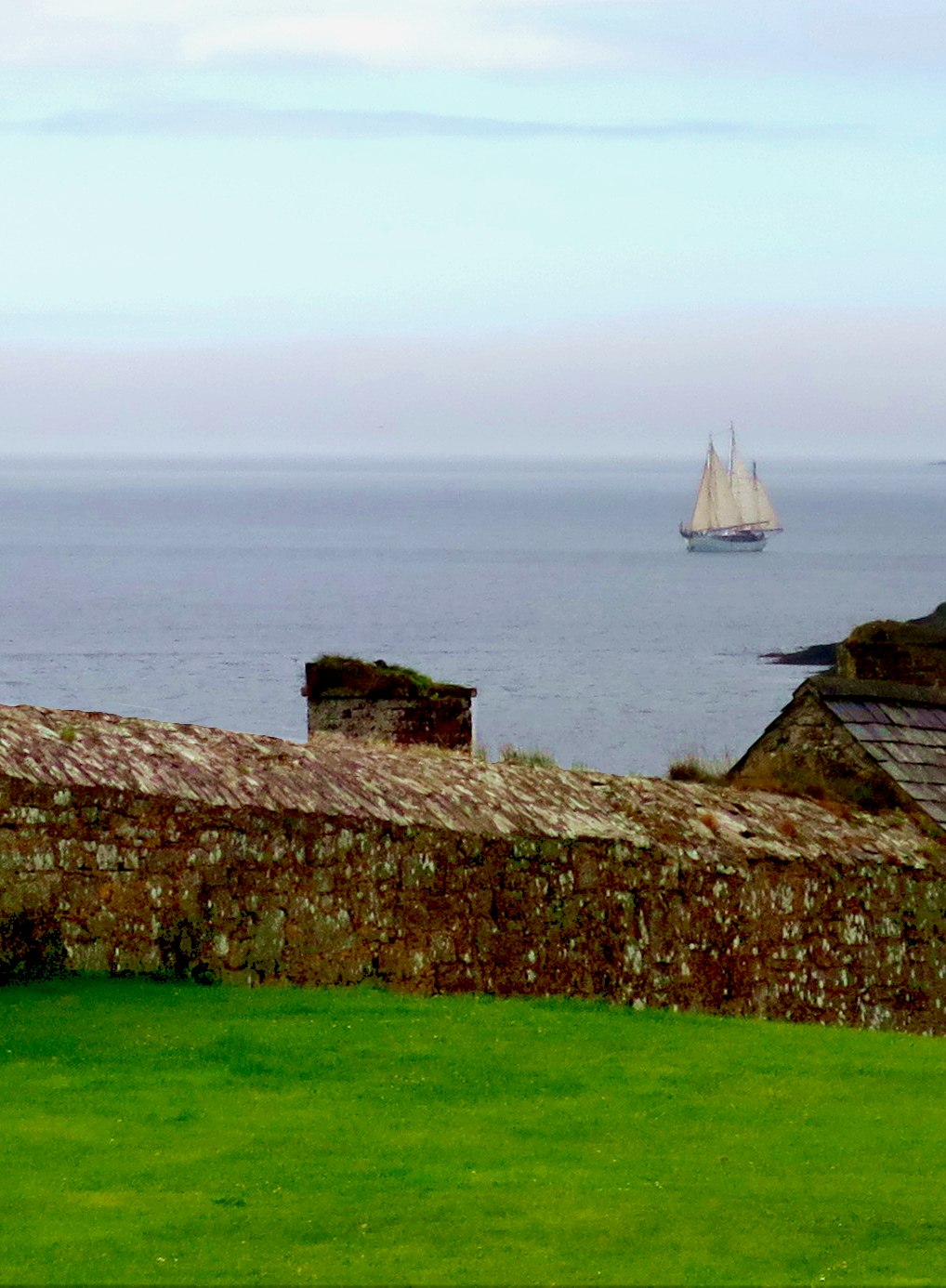
When I look at this picture it reminds me of my teenage years in Malta, when we would go down stony paths that wound through ancient stone fortifications, and then swim off the rocks at the shore. But if this had been Malta, I'd have taken the photo in winter or early spring, because the flowers in the foreground would have been long gone by the time the blazing hot summer arrived.
Anyway, as the title of my post suggests, this picture doesn't show long-ago Malta. It shows an Irish scene - a view from the coastal path towards Charles Fort, at Kinsale, Co. Cork. The water around the coast of West Cork is beautifully clear, and half a dozen people in the sea were clearly having a wonderful time, even though the water probably wasn't too warm. Even the sunshine didn't last, because Irish weather changes by the minute, and two hours later the scene was foggy!
I've been wanting to get to Ireland ever since I got my Irish citizenship during the Covid pandemic and I finally made it earlier this month.


...marks the fort's arsenal - that building with the pointy roof . It was packed to the rafters with explosives and guarded 24 hours a day. Any soldier who needed to enter it, for whatever reason, had to strip down and put on a linen smock and wear wooden clogs on his feet, an outfit considered to be less inflammable than his regular uniform.
The soldiers' married quarters are just opposite the arsenal! The building would have been crowded with women and children as well as soldiers, so they'd have been the first to go up in smoke if there'd been an explosion. You can't see the officers' quarters in this picture since they were separated from the arsenal by a huge wall. It might not have protected them much, but perhaps it made them feel safer.
It's generally thought that only officers were allowed to take their families with them on their travels but according to our guide, some soldiers also got the opportunity to have the family along, even if it did mean living next to the gunpowder. My great-great-great grandad seemed as if he may have been one of these. Apparently, soldiers had to enter a lottery if they wanted to be accompanied, and if they drew a winning ball, the family would be provided for. Their wives and daughters cooked and cleaned, while the sons were either enrolled as soldiers as soon as possible, or became bugle-boys or other undesirable jobs. There was no privacy and several families lived together in one huge room. But still better, it seems, than staying back home on the farm.
My great-great-great grandfather's name was John Harper, and he was born in Halesworth, Suffolk. His wife was called Catherine Miniter, who had been born in Scarriff, Co. Clare. The pair married when they were both in Canada, so Catherine's father, (who was also born in Co. Clare) was almost certainly a soldier too. In that case, she'd have been well used to the military life, and the nine children she and John produced all survived to adulthood, even though every one was born in a different part of Ireland, England or Canada.
I tried to imagine her travelling to and across the Atlantic with the children - almost certainly in steerage - pregnant a lot of the time and frequently suffering Canadian winters into the bargain. As well as this, the Fenian wars and other instability were plaguing Canada - which I suppose is why my great-great-great grandad and his father-in-law were out there in the first place. Sadly, I don't know where and when Catherine died, but I hope she got back to Clare eventually, like her dad apparently did.
"Miniter" is an unusual name which still survives in Clare. Many Irish records before 1850 have been destroyed but the name may be Norman French in origin, and I have the beginnings of a plan to visit Scarriff on my next trip to see what kind of a place Clare is.
To return to Kinsale, it's the site of a battle which changed the course of English and Irish history. Walk along that lovely coastline and you'll come across a few signs like this....

...and if you like military history, here's more information.
The town of Kinsale today could hardly be more different from how it was then. Now, it is a pretty old place, with houses painted up in many colours, and a lively "foodie" culture. They're proud of their Michelin-starred restaurant, "Bastion" and there are several other highly rated restaurants offering different cuisines, not to mention great artisan ingredients to buy. How times change, eh?
Here's one other photo that I liked taking at Charles Fort. These structures are by the main gate are connected with the water supply, but I love their simple and satisfying shapes. I just wonder how they worked. Were they bases for wooden water tanks? Or did the troughs fill with water? Is that a well in the middle of each one?

In the end, Charles Fort rather fizzled out. It only saw combat once, in 1690, when it was attacked by King William of Orange. After a thirteen day siege, King Billy breached the walls, helped (according to the guide who showed us around) by a sleazy sounding guy who had supervised building the fort in the first place. Not only had that man creamed off money from the building for himself, but he also told the enemy that the eastern walls hadn't been properly built, so naturally William concentrated his attacks there.
After this, Charles Fort lingered on and eventually fell into ruin. It's now run by the Irish Office of Public Works, which I can't imagine will ever give it up or sell it on. Before they took it on, though, the fort had a brief period in the 1970s when it ws occupied by a hippy encampment. That's the time I'd have liked to known it. What a nice spot to go and sit and think about peace & love, have a nice swim on a hot day, and look out at the ever-changing sea.