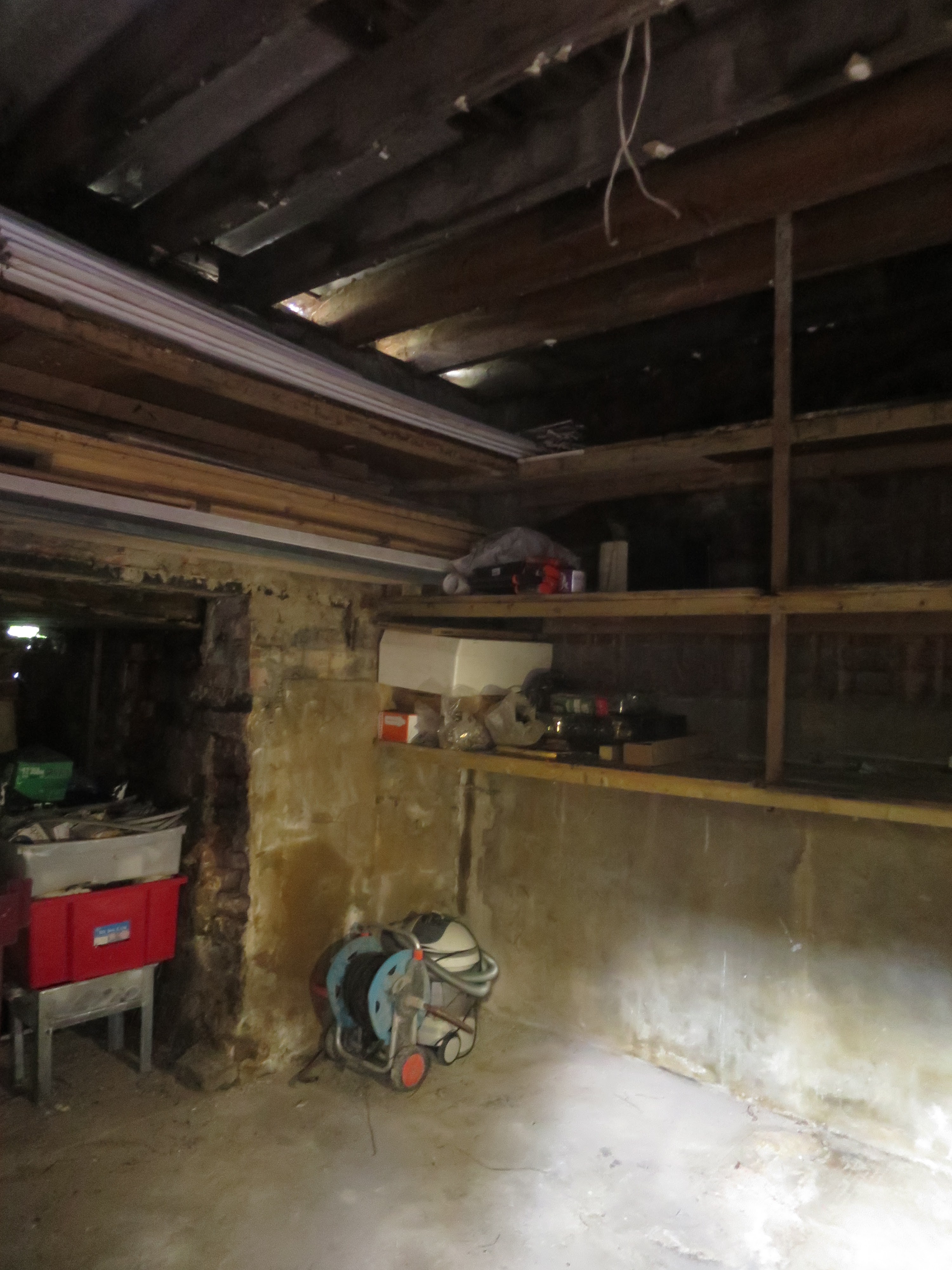
My old friend Adullamite gave me a prod the other day to write something, anything. And I agree he is right, though to be honest, I have always thought of this as a travel-related blog, and, of course, going anywhere or mixing with new people is exactly what we're now constantly being told to avoid at all costs. Still, we had an exciting event in our communal garden last week. Or at least it was exciting to me. Do you remember that story about the woman in New York who found another apartment behind her bathroom mirror? Well, we found a secret building in our garden!
We live in a flat in a large Victorian house which is built around a 3 acre garden square, (or, in fact, a rectangle.) It is behind the houses, and it is quite invisible from the street, and it slopes down the hill from top to bottom.
At the top of the hill is what used to be a gardener's compound, with a shed and glasshouses. The glasshouses have long gone, and the shed is full of garden equipment. Next to this compound, for as long as I can remember, has been an ivy clad brick wall in poor condition, accessed by a locked door. It appeared to belong to a nearby mansion block.
But actually, it doesn't. Someone in the block took it over without permission years ago and gained what I believe are known as "squatter's rights". Now, our garden chairman is working with the local Lord of the Manor (I kid you not) to reclaim it, and, last week, I was able to walk through this door, and have a look.
There was a brick building dating from about 1910, with a little courtyard and a passageway leading round the corner and onto a neighbouring street. The whole area had been neglected and choked with rubbish for years, and definitely needs total renovation, but now the main building has been cleared to reveal a fairly spacious room with a blocked up window, and a smaller room off it. The legal situation is still unclear, but various possibilities are opening up. Conservatory, storage, residents' meeting place? Who knows? We can't do much until the legal situation's fully resolved, but it's something to think about, and strangely exciting.

T and I have been busy. After we received our first vaccinations, we home-schooled the twins till schools returned on 8 March. They'd been quarantining since early January, with online Zoom classes and work to be done at home. We had to supervise this, and found that Zoom is a terrible way to teach. Pupils of all ages seem to struggle, mainly because there's none of the give and take of normal school life. As the twins held their wobbly pencilled work up to the screen in bright sunlight, it was clear that teacher wasn't going to be able to read much they'd done, let alone give useful feedback.
After they'd finished their schoolwork each day, we taught them things we thought they'd like to know, practised reading and tables, took them out and played with them... and we also made a movie. It was supposed to be three minutes long but somehow turned into an exciting adventure to which they contributed lots of dialogue and ideas, and ended up at eighteen minutes.
It was all fun and we generated far more noise than usual - not just shooting the film, but playing, dancing, shouting, racing around - with me editing the sound track of the film into the night, and we did worry a bit about what the Persian couple living downstairs might be thinking, since the place is not that soundproof.
But they said they liked the sound of children bringing some life into lockdown, and were, in fact, very nice about it. So I thought I might buy them a card for Nowruz, the Persian New Year, which is this weekend. And that meant a trip to the nearby area of Kilburn, where I'd heard a Persian shop or two had opened up.
It's about a mile walk to Kilburn High Road from here, and in all these years I've never found it to change much - a busy, slightly shabby place with heavy traffic and many immigrants. It's okay, with some nice shops and cafes, a good cinema and theatre intermixed with pound-stores, bookies, slot arcades and pawnshops, lots of dust and grime.
There are always plenty of bits of Kilburn that seem to have seen better days - like the Red Lion pub (above) here, once a glittering Victorian gin palace, now a sad sight with steel security doors and broken windows.
You can see by the huge mosaic plaque built into the space between its chimneys that this pub was once really proud of itself, announcing it was established in the year 1444...

...and rebuilt from this - below in 1890. The pre-1890 Red Lion looks charming to me, but no denying that the rebuild was on a much grander scale and this little Regency building no doubt seemed pathetically small and outdated, specially if the owners were were planning to compete with the Black Lion down the road, which supposedly dates originally from the
sixth century, and what's more has a magnificent Victorian interior - read more
here about the Black Lion.
For centuries, both Lions, and all the other pubs of Kilburn High Road have done well. That noisy dirty thoroughfare around which the place is built is in fact part of Watling Street, the incredibly ancient road which leads from the Southeast of Britain, all the way to Wales in the North-West. Most of it is still in use today, suitably modernised. I find that amazing, considering the Romans paved it around the time of the birth of Christ. You'll find more about Watling Street
here.
Kilburn must have had so many inns because travellers on the road would have been seeking a place to eat, drink and stay for centuries. Just across the road from the Red Lion is the Juniper, known for most of its life (since the 15th century) as the Cock Tavern, possibly because it provided entertainment in the shape of fighting cocks. Nice. It has only recently changed its name, when it was refurbished, only to find that lockdown hit. Its website isn't functioning, and I don't know if the business has survived. (I think those are plastic flowers hanging outside, so they don't signify much). We should find out before long.

I am not alone in in wondering how our towns and cities will change after more than a year of being closed down most of the time. In particular, it's hard not to wonder what will become of London (not just the pubs but the property prices) after this pandemic. But if 2020 taught me one thing, it was that I can't foretell the future, so I don't bother worrying too much. Strangely liberating, that.
Anyway, when T and I arrived at the southern end of Kilburn High Road, we found that it had come up in the world so much that it almost didn't even look like Kilburn any more. There are some fine new buildings, including a library, lots of apartments for sale, a brightly-coloured bit of architecture that's a new school, and, in the middle of it all, a section taken over by some Persian shops and cafes - a bakers, a supermarket, restaurants and a beautiful lounge selling all varieties of cakes, including big red rose meringues decorated with gold leaf. I am afraid I had to take photos on the phone, which is not really up to the job, so my picture doesn't show these cakes in their true splendour, glowing in their lighted cabinet in a dimly lit lounge.
The supermarket and its adjoining shops were all so busy with people shopping for New Year that I didn't take many photos, nor did I buy anything. (Instead, I asked my daughter V. to pick up something at her local Persian shop in Southeast London, "Persepolis," which has a more covid-compatible layout. Here's Persepolis's website, and when things get back to "normal," (whatever that is) I recommend a trip to their nice shop and cafe when in Southeast London.
Back in Kilburn, I snapped these bowls of sprouting grass, "Sabzeh" for sale outside the supermarket. This signifies renewal, and I am told that sabzeh is one of seven items, all of which start with "S" in Farsi, which are used in celebrating the new year.
Another indication that this bit of Kilburn is going up in the world is a piece of street art I'd never seen before - a sundial where you yourself point to the time. The months of the year are incised around a north pointing line on the coloured square shown below, (take a this picture on Flickr shows it much better). This was the exact moment when the sun obligingly came out (for about a minute) in the whole day!
Public artwork like this suggests that someone is taking an interest in the area, so it was good to see.
On the way back, we passed an early magnolia in full bloom, shining out under the dull, dark sky. (I have lightened the picture considerably to show the magnolias better)
On arriving home, I decided to treat myself to a Japanese sweet, the last one left in a box that was sent to me by a friend last Autumn. I think they are made of bean curd and most of them contained tiny jelly models of autumn leaves, but this one contained a fish. It didn't taste of fish at all, but the pale blue-grey jelly is clear and perfect, and when you start to eat it, the reflections of where the jelly has been broken, make it look as if the fish is swimming in water.
I thought it was almost too nice to eat.
V did get a card and small gift of chickpea cookies at "Persepolis" so I cycled into central London to collect them and to have a little stroll around with her. We couldn't believe we had missed this memorial to Agatha Christie, the detective writer, (shown below) specially since we'd spent about half an hour standing around exactly that spot, in Great Newport Street, just a few weeks ago. Despite its large size, it must be one of the most unobtrusive monument in London! I assume that is a lifelike bust of her.
It was put up in 2012 and contains biographical information and lots of little images, plus a list of her books, which continues on the other side of this double-sided monument. Several have their titles in Braille - a nice idea.
We bought a takeaway coffee at Orée, just off Bow Street, and I couldn't resist buying a charcoal baguette too. It is totally black inside, and looks intriguing. It tastes good, too. I've had charcoal biscuits before but never charcoal bread, though apparently it is good for the digestion.
And, as always in Spring, Nature is its usual eyecatching self.
Early spring is one of my favourite times of year, and the willows, heavily pollarded last year, are now exploding with new leaves.
Well, Adullamite, will that do? I hope so! I am glad that you encouraged me to write a post. There was quite a lot to say, after all.