Showing posts with label malaga. Show all posts

Saturday, 6 August 2022

And So, Here We Are....

Well, I'm sorry to say that for weeks and weeks,  I've been suffering from a torn hamstring. It has been taking ages to get better, and, on top of that, T. has managed to put his back out.    So things haven't been easy, though we've kept going, more or less.  Like, we went to Spain, and it was very good.  We spent several days in the lovely old city of Malaga, where we have stayed several times before, and which always has something to see....

...like this huge glass box full of potato chips, large enough to hide a man in...


...which seems to me like something fitting a crime novel. I could imagine a villain hiding inside it waiting for the chance to burst out in a shower of fried potatoes to commit his terrible crime.  Could you hide a body amidst those thousands of cheese 'n' onion fragments? ( the idea of that didn't tempt me inside to buy a paper cone of the things...  ) 

I thought of another question each time I passed the shop. How do they get the crisps out if people want to buy some? Does the assistant open the door and get buried under an avalanche of crisps? Or perhaps the crisps are not actually for sale, and are just for show, going slowly stale... Do they attract mice,  or could they be made of plastic?  So many questions.....and now I'm back in the UK I can't even go into the shop and check for myself.  Although that would have spoiled the fun, in a way.

Malaga is apparently one of the cultural cities of Spain, and it does have some great museums. It is also happens to be where Picasso was born.  But during this visit we didn't do very much. We just ambled about and went to only one museum, the Museum of Glass and Crystal.  

Its doors had remained firmly shut last time we were in Malaga but this time it was open, and we found it a complete thrill. It is a fairly new museum in an old palacio, restored by its benevolent-sounding owner,  Gonzalo Fernandez-Prieto, who actually lives in an apartment on the top floor. He has arranged his own large, imaginative and varied private collection of glass, crystal and antiques to feel as if you're taking a tour through a private house.  So, no barriers, few labels, and glimpses of a beautiful garden outside. You also get a guide who speaks your own language, and the overall cost is very reasonable.   This Tripadvisor link  gives a very good idea of what it is like, and if you are interested, I suggest you take a look at the pictures on the link.   I liked far too much of what I saw to show it all here.  But my picture of an 18th century goblet shows how the guide was free to handle it - he held it up just where I asked to photograph it. Not been made to be locked forever in a glass cabinet, but to be handled and held, I like to think Mr Fernandez-Prieto might have had his friends over sometimes to eat and drink off his glass treasures.


One of the nice things about it being a personal private museum is that he was able to label the restrooms with incredibly rare Andy Warhol glass to show which door was which.   (That's Andy on the right).

As I said we've been to Malaga often, and on this trip we stayed in the square shown below. It's really central and as we were several floors up in an old apartment block, we could watch life happening below without having to participate in the bustle or noise unless we wanted to.  We mostly did want to go out in the evening - the place was cheerful and lively and very clean - the trucks come round twice a day - and there's a lot of very good, inexpensive food to be had.   

During the day we liked to stop by the cathedral to watch pigeons skimming up and down by the fountains nearby to drink or wash. I like how this one sticks out its head and tucks its little pink claws in as it lands.
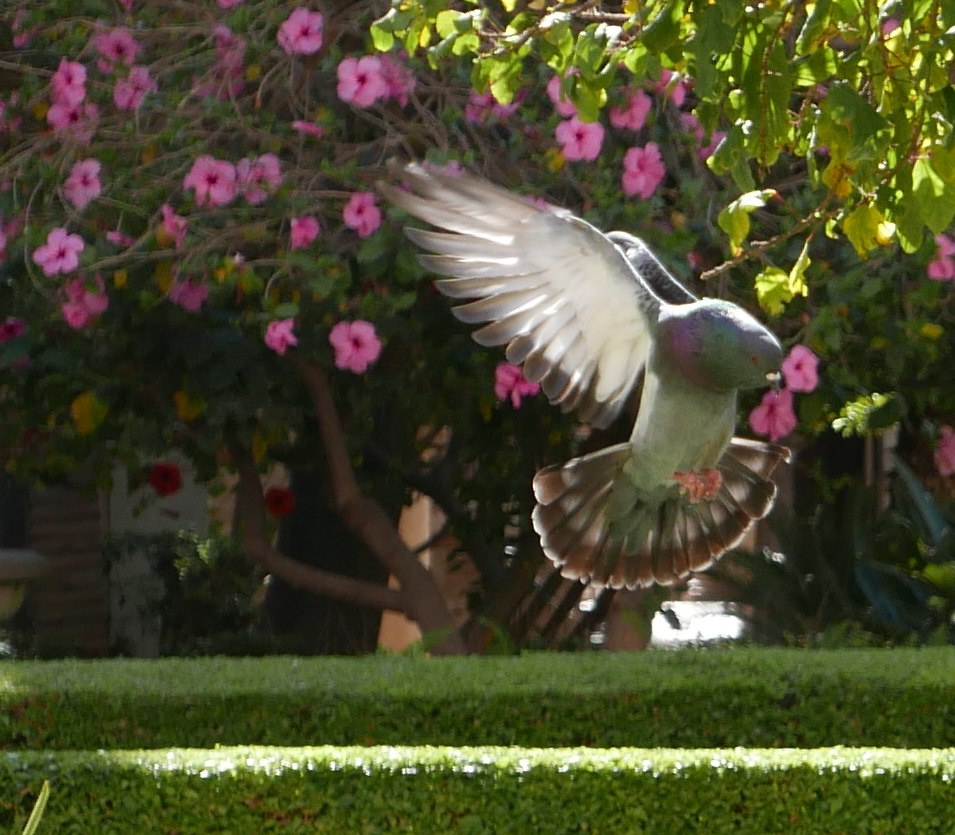
The jacaranda trees in  Plaza Merced were in full glory - they only bloom a few weeks of the year but it's magic to see them against a blue sky.  


So Malaga rocks, and we had a day longer than we bargained for when our flight home with Wizz Air was cancelled a few hours before takeoff. It cost us £800 to buy tickets back to the UK next day. We're still trying to get the statutory compensation for late flight cancellation (400 euros each) out of Wizzair for a nightmare fllight experience.  But being in Spain was a tonic. 

Next, a return to Herefordshire, which I mentioned in my last post.  Below is a photo of the excellent lady guide to the Painted Room in the charming town of Ledbury.    The room shown is a local government office, rather surprisingly.  Until the 1980s, everyone had forgotten it ever had been hand painted, but some sharp eyed workmen spotted the designs as they removed old wallpaper during some renovations.  So the conservators were called in and the room was revealed. 
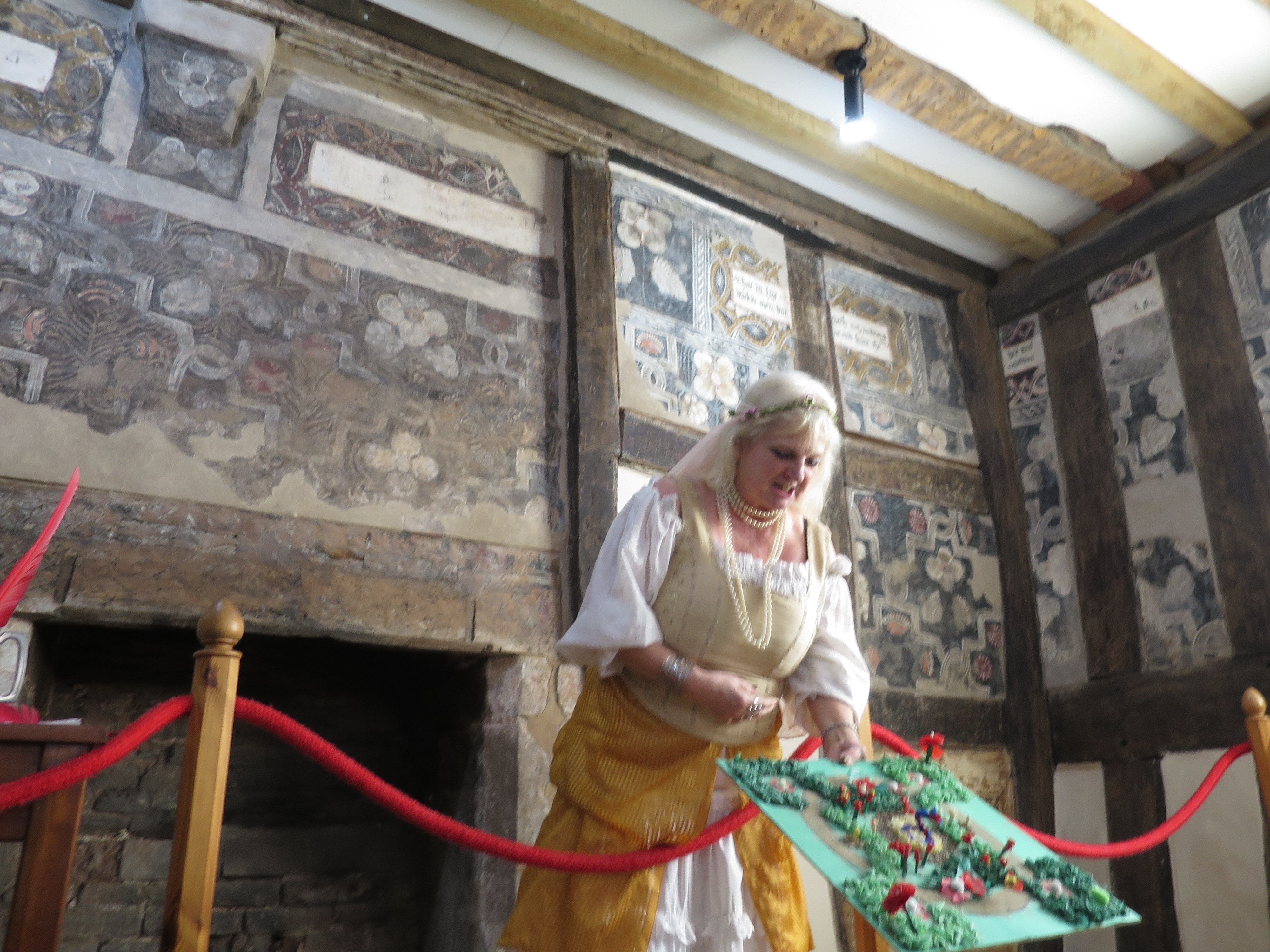
The guide is showing part of a children's project about knot gardens, a type of aromatic herb garden laid out in a maze of little hedges.  That is because the painted wall decoration is based on knot gardens, which were the height of fashion in Tudor times  She told us that the room was apparently designed for a man with the interesting name of Mr. Skull in the 16th century. Back then it was used for public business and meetings, just like now, since Mr. Skull and his family were the building's resident caretakers.

  I felt very grateful to Ledbury's council for letting us have this little glimpse of the past, and providing such a good and enthusiastic guide.   

We also hit the Hellens Music festival. "Hellens" is another very old house, even older than the Ledbury painted room.  In fact, it originally belonged to King Harold II.  (And if you thought at first that you'd never heard of him, think 1066. He was THE King Harold whose eye was put out by William the Conqueror at the Battle of Hastings.)     Hellens is now privately owned by a family that loves music.   Every year they run a series of masterclasses for young chamber musicians, culminating in a festival week of wonderful performances, which are held in an old barn.  It's really, really informal, and the atmosphere is quite inspirational. A cat came along to attend each performance I was at.  I am sure it found it inspirational too, and appreciated everything about it, just like we did.    

There was also a charming dog who liked to play ball with the guests on the lawn afterwards.  Hellens really seemed to me to be the kind of house I'd rather like to live in if I was extremely rich. 


The grounds are laid out in a mix of formal and wild, with donkeys and hens, and there are the sounds of musical happiness everywhere.  Click the link if you want to see more about the music festival


Later in June we had a few days in Norfolk.  By then, my hamstring was making things difficult.  But a trip to Wymondham (pronounced "Windham") cheered me up.  It is a nice old town with some nice old pubs and shops, and a reasonably priced local teashop called the Mad Hatter, with home made food (click the link to see their Jubilee afternoon tea - yum).   Wymondham Abbey, the local parish church, was very unusual and well worth visiting the town to see. At first I thought it was ruined but it turned out that the building had originally been a 12th century monastery. at some point, the nave and north aisle of the monastery were hived off to be used as as parish church by the townspeople. 
 
So there were now two rival groups sharing a big grand building - what could go wrong?   Well, of course everything.  The bitter rivalry between monastery and townspeople was finally settled by Henry VIII, who closed all the monasteries in England for his own greedy purposes.    That left the townspeople triumphantly in possession. Unfortunately they didn't have the money or the population to maintain the monastery so they just let it fall down, or else they demolished bits as they needed them for the splendid stone. It was Caen stone, laboriously brought over from France. Which was no mean feat in the 12th century, specially since Wymondham is not on the sea. 
 

So now Wymondham parish church is a slice of monastic cathedral:  immensely tall, with gigantic Norman arches, a clerestory, a dazzling altar, old stained glass, splendid roof, and so on. But there's not much of it, so it doesn't have the paid staff, the offices, the shop, the side chapels or all the other things a cathedral has.  It is left to a handful of local people and their vicar to keep it open and running.


They do a good job. 


 Services are centred on the magnificent nave, but the vicar had used the aisle, with its fine old triptych and ancient carved roof, as a meditation and calm space. (see below).  You can see the comfortable sofas, the flowers, the lights and the beautiful stained glass windows (though unfortunately you can't see the stained glass in my photo).   No effort has been spared to make the atmosphere incredibly peaceful, calm and welcoming.  They wouldn't have been able to do that if it had been a cathedral. So, everything has worked out for the best. 


After this, the various muscle issues kept us in London for a while, and we had to cancel a trip we were going to take to Sussex.  But we haven't been sitting relaxing at home, oh no.  Various events in our wider family have meant that we're seeing more of our  grandkids than usual, not only the twins, who are their usual bouncy selves, but also S, the oldest, who has been staying for a while as he revises for an examination.    It's wonderful - they're friendly, helpful, companionable and full of ideas and enthusiasm.  What's more, there has always been someone around to pick things up off the floor, carry bags, move furniture, (in the case of S) and chat nineteen to the dozen.  I am sure it's good for the health. T. is almost better and I feel I am now on the mend at last. So I hope we can make our next trip,  which is only next week. I'll keep you posted. 

Monday, 22 April 2019

Happy Easter!


I hope you have, or had, a wonderful Easter! Here are some of the beautiful Easter birds, with their chocolate eggs, who temporarily inhabited the windows of the chocolate shop in Fuengirola, where we have been during Holy Week. 


 Fuengirola is a small town on the Costa del Sol, Spain, and we were there with one of our daughters, her family and her in-laws.   T and I flew into Malaga and so took the chance to spend three days there. I like the city very much.    

Holy Week, (Santa Semana,)  is very important in Andalucia, and we are all still a bit dazed by the huge and amazing processions of Jesus and Mary on their ornate silver and gold floats, lit by dozens of huge candles and carried mostly by men, some of them blindfolded, others in long robes, preceded by robed penitents in long pointed hats and always accompanied by a band.  

The masks and robes of the penitents can seem quite frightening, partly because the evil founders of the Ku Klux Klan have perverted them by adopting very similar robes.   The confraternities which run the processions are of course devoted to helping the sick, living holy lives, etc.  


 It's hard to convey just how extraordinary it is to have these processions going for hours through the workaday streets of the town.  Every afternoon evening and night in Holy Week is given up to it - it's very much a living religious tradition with all ages and both sexes participating. 


 The atmosphere of the processions is exciting, positive and family centred. 


All traffic is stopped and a large proportion of the local population takes to the streets, often till the early hours - and the shops and cafes stay open too, so the town feels fully alive.    

Many children and young people collect the wax from the penitents' long candles, and at the end of the day the penitents' robes are often bespattered with wax. 


The vast majority of people at the processions that we saw were local, and it was very much a social as well as a religious occasion.  I suspect it is a custom that has its roots in very long tradition. 


However narrow and maze-like the streets, the floats will get there, and the carrying of it is a highly skilled affair. This float arrived outside the tapas bar where we were having a snack at about 11 PM. 


Nothing is mechanised, the floats are carried by human effort for hours and hours, often until the early hours of the morning


.  It is clearly very tiring, and some of the bearers also do the work blindfold.  Here are some of the bearers taking a rest in Malaga.  


They were carrying a most spectacular float of the Virgin, and some of the candles were being renewed and relit by a very strong fellow carrying a long taper.  Can you see him on the left?


I haven't downloaded all the photos yet, and there is so much more to say, I suppose -  but I will post this now, as I wanted to wish you  a Happy Easter before the holiday ends. 

Friday, 1 April 2016

Badly Planned in Spain

I hope you had a good Easter.  Our idea was to take a few days in Spain, accompanying family members, just for fun.  We hoped to see the Holy Week (Semana Santa) processions too with their strange looking crowds of penitents in pointed hats.  (In case you don't know, there are several processions in mostly Andalusian towns and cities, each organised by different fraternities, each of which has penitents, a Crucifixion float and a Virgin float in the run up to Easter.  Go here for more information).

Since it wasn't  a working trip I didn't plan and assumed it would all be fine.  And it was fun, but still, I'm never going to skimp on the planning again! Haven't had so many disasters since a terrible trip to South Africa with a group of journalists and PR people who were literally knocking seven bells out of each other, the airline lost many suitcases and the hotel staff were stealing everything that wasn't nailed down - among several other problems. (But that's another story....)

It was the no-planning that caused most of the problems, not Spain itself.  And so despite many tears (not only mine) I'm really glad I went.     Semana Santa alone made it completely worth it, but there were many other wonderful things too. We were a couple of days in Seville, which was terrifyingly crowded (I'd broken the Planner's cardinal rule: never visit in high season. ) The crowds meant long queues, high prices, some spectacularly bad food and service and T's phone was lost or stolen in spooky circumstances. I also picked up a nasty bug,  which is still with me, and had to invoke my insurance because I was too ill to fly home.

Despite this, Seville did not disappoint.  I'm definitely going to return (off season).  Its Semena Santa processions are famous, although crowded, and I found this candle lit procession followed by an almost black Christ on the Cross rather thrilling. Although we were crammed shoulder to shoulder in the huge Plaza del Salvador, the vast crowd became quiet and attentive when the floats appeared..


A day or two later we stumbled, shellshocked, onto the Malaga train. Oh yes, RENFE, the Spanish rail network, seems to plan strikes at top holiday periods. Don't ask.  But we managed to get to Malaga, which is up there with Madrid as my favourite Spanish city.

 Malaga has a hinterland of high rise flats and hotels, but also a noble and fascinating history, some famous residents alive and dead (like Picasso and Antonio Banderas) wonderful architecture and a friendly atmosphere - not to mention good weather.

The walk to our lodgings from the station, normally about ten minutes, took us well over an hour as processions were in full swing.  We got much nearer to the floats than we had in Seville, and it seemed like a very different experience.  

Some of the men shroud or blindfold themselves when carrying the suffering Jesus (you can see one joining the back of the float in the video below). The float sways characteristically from side to side as the men march in a peculiar shuffling step. They have to lay it down every couple of hundred yards or less, for modern technology is not used- for Semana Santa, it's all human muscle power and candle light.


The suffering Jesus is a sad float, and of course the Virgin Mary is sad too. She's always a beautiful and innocent young woman weeping helplessly. But her float is an excuse to go right over the top, with dozens of huge flickering candles, (when dusk falls) hundreds of flowers and a long, long train beneath which she shelters her devotees.  As I noticed when I lived in Malta, the Virgin is a pin up of wondrous holiness.

She also tends to get brighter music, like this very Spanish sounding music below. Of all the floats I saw in Malaga, this particular Virgin probably had the most specular cloak . You can see that even getting round the corner is quite a business.  (It's filmed from the balcony where we stayed.    I got as close up as I could, but try and view full screen if you can.)  You can see the men lifting the float as the bell sounds.


 And no, we didn't get much sleep that night. I woke at 4.30 and I could still hear distant music. But it was worth it.

As for the penitents, they are very, very disconcerting for someone like me who is not brought up in the tradition. They just look so weird, striding around the city streets, like groups of wizards.


Many children marched in the parades, which must have been very demanding for them as they went on a long time and required perfect behaviour - and we never saw anything less.


From Malaga we took the local train to Fuengirola, where the in-laws have a holiday home. This time, we stayed by the church door, where the floats arrive, position themselves so that the holy ones can look down the entire length of the open church and pay their respects.  


After viewing the processions, it seemed the natural thing to do to go and have a coffee and a cake. 


If you haven't had enough of processions, this clip is perhaps my favourite. I love those Spanish looking faces. Some of them could be straight out of those 17th and 18th century paintings in the Prado.  It also gives me a feeling of how heavy and difficult it must be to carry those huge floats for hours and hours.


If I haven't yet got round to commenting and visiting your blog, I will do it very soon.

Tuesday, 6 October 2015

Malaga - and Oxgate Farm.

Revamping the kitchen, sorting out tax and finances, a lot of twin babysitting ... and I've been invited to try my hand at some interesting projects which I hope to share with you soon.   Seems like a perfect time to share the pictures of Malaga that I promised months ago. 

But, first, I just want to mention that on the way to the DIY superstores in Brent (a place which could act as a location shoot for a dystopian movie) I passed an amazing house on a dreary road. Surrounded by light industrial and nondescript semis, it was in a ghastly state of repair and partly boarded with corrugated iron.  But I knew from its shape and construction that it must be really old, so when I got back I googled around and found that it is called Oxgate Farm.  Take a look at the pictures on its Facebook page, specially the ones where they've dressed up the inside. Wow! What an extraordinary survival - and to think Shakespeare himself might have visited. It's very much at risk, and so I've written to the SPAB about it and joined the FB page and I hope something can be done about it.  I will keep you posted. 
  
I've chosen some of the Malaga pictures to give you a feel of what it's like to spend a day in the "old town" (as distinct from the touristy bits which look much the same all along the coast).   The photos were taken in February, and show why Southern Spain's such a good place to escape the English winter. 

So, early one morning, we got up and wandered into the main squares in the town. Felt like paradise after England's grey winter skies. Here's someone having breakfast and reading the paper in the slanting morning sun. 


Because it's winter the shadows were long but very pretty.


Always there are little shrines in the wall - and isn't this wall painted up interestingly. I think it must be a Moorish design. 


Spanish shops often seem to be shut, or at least they are when I need them, but they are open on weekday mornings. We often go to the indoor market to get food, but delis are also fun, and this one, with its toys and sweets alongside the nuts and dried fruits, must attract kids as much as adults.


We always eat fish when we go to Spain and this is the kind of stuff we buy for souvenirs.


Yes, Spanish dancing outfits.  The twins already have them as their other grandparents have a holiday home in Spain.  They don't half look cute in them.


Are these hats?  The window sign says "biretta" but I mean, seriously, what are they?


About midday, we strolled down to the port, recently redesigned in striking style with a dazzling white canopy like a snake skeleton. It was like being inside a giant architectural model, all clean lines and glass, a beautiful bit of architecture. You can see the canopy reflections in the shot below, which was taken through a sheet of glass.  I love the bright blue and white feeling of it all.  It reminds me of my childhood when I would get on a boat often to go somewhere new.


All so bright and twinkly.


Further along there is the wide sandy beach, swept clean, with empty kids' play equipment and  nobody swimming.  February is February, after all!


There's an old Moorish castle on the hill above Malaga so we went there as the afternoon siesta took hold of the town and all the shops closed.


Past the cathedral en route.


And from the castle, there were  wide views over the town.  The holiday flats in the background are typical of the places that give the Costa del Sol a bad name, although I expect those who own them have a great view of the sea!


The castle's main structure is restored, though the elaborate interiors have been mostly left plain; I can't begin to think of the cost of restoring those.  It's none the worse for it, though, and we were happy to amble round the gardens and pathways and sit in the shady corners.  


I wished, though, that I could have brought along my friend Yehuda, a keen amateur bricklayer who would have gone into raptures over this restored ceiling.
 

When we got back to town, evening was coming on, the clear sky was a deepening blue, the street lamps were on. Things were starting to come to life again. 


By 7 PM the streets were bustling with shoppers, the marble pavements reflecting the light from the windows.  I bought some almonds from the almond seller who had been sitting there all day.  There he is on the left, with his tray of almonds.


And by 8.30 the bars and restaurants were showing a few signs of life.  I've never got used to the late eating hours in Spain, and in February the old town doesn't have all that many foreign tourists who keep earlier hours.   This is the El Jardin restaurant and bar.


Here's a close up of the traditional Amstel pump on that counter.


If we'd been with friends and family, we'd have waited to eat until the restaurants filled and to hell with the indigestion.  But we didn't want to wait, so we set off to find a restaurant where we could eat outdoors, just because it was February and we could sit outdoors....   


A fantastic paella and a lovely evening.  Guitarists jammed away happily in the dark shadows nearby


And the cats came out to claim the night.


 PS.  I didn't mention the Picasso Museum, but it deserves a post of its own. Since I can't do it justice here, this video might give you a taste of it, and


here is one of my favourite pictures in it.


It is also a gorgeous building. Look at the contrast of this wooden ceiling with the plain walls and staircase.  One of the things I love about Spain is the sense of style.


Blog Archive