
Thinking about folklore (in the last post) got me thinking of the Cuming Museum, one of London's smaller and lesser known museums, which I've had quite a lot to do with lately. It is set in the Elephant and Castle area, in Southwark. There's one of its exhibits above - hair cut from the head of Prince Charles Edward Stuart, Bonnie Prince Charlie.
The Elephant, as it's known, is a very historic bit of London. Historic, but not that appealing in recent years. Walworth Road, where the museum is, was once very grand, with big houses. Then it became run down as the big houses became slums and public housing was built. Now, there is a big regeneration project coming along, with the idea of bringing the area up again.
The museum occupies a few rooms in a grand Victorian building, and it's full of curiosities, mainly collected either by members of the wealthy Cuming family or the London folklorist Edward Lovett between the 18th and 20th centuries.

So in some ways it's a bit like a sort of costume-drama version of "Ripley's Believe It Or Not" - except that the items on display are genuine. Because they were carefully collected by individuals, nearly all of them are in some way thought provoking, touching, creepy or just downright weird. Many cast a light onto the corners of Old London that we never hear about now, the world of the poor and superstitious, the Dickensian masses who battled to stay alive.
The museum hasn't nearly enough space to display its collections, which is a pity, but the displays are often rotated, and every time I go, I see something new to intrigue me.
And also, every time I go, I somehow take really, truly lousy pictures. Perhaps all that magic and folklore has cast a camera-busting spell on the place!
Anyway, sit back, relax (you might as well unfocus your eyes... you won't need focus) and I'll tell you a bit more about it.
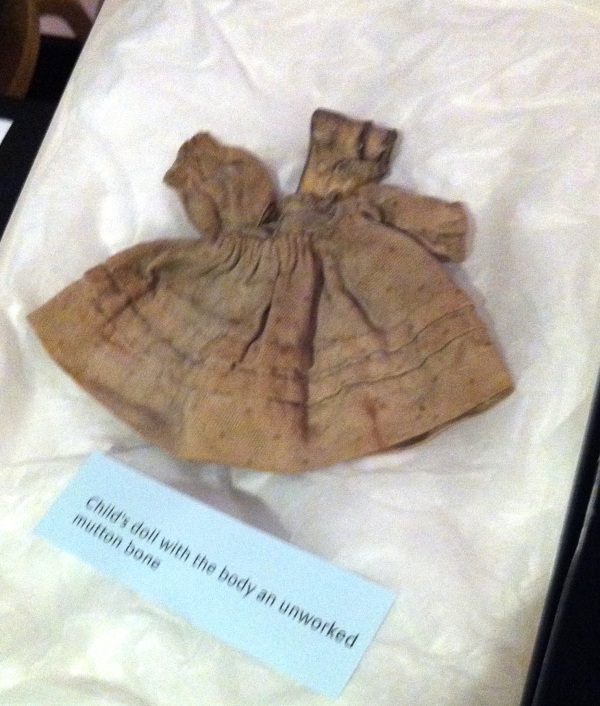
This is an old mutton bone in a frock. Over 100 years ago, some poverty stricken child found an old baby's frock and dressed a mutton bone in it because there was no way to afford a doll. It was carried round and nursed and loved, and it was spotted by Edward Lovett. Lovett would walk around London in the early 20th century, seeking out London's home made toys, effigies and charms. The original little owner of this object was offered a nice new real doll in exchange for her bone. Wonder if she grabbed it eagerly. I hope so!

Lovett was so interested in folk magic that he designed this magical mascot for a motor-car. It's shaped like a horse brass (since cars were rather new at the time) and he has incorporated various magical symbols to protect the car's owner from harm. I want to find out more about this interesting man!
And this, below ... Do you really want to know what this is? Really? Well, it is a Victorian dentist's hat. You can see he has covered it with some of the teeth he has successfully extracted, as a tribute to his skill.

I'm pretty sure the dentist dates from the "slum" period of Walworth Road's history. I really can't see the nobility and gentry going for anyone who wore a hat like this. But, in contrast, the collection also includes this souvenir acquired during Richard Cuming's lifetime - he lived here 200 years ago or so, when it was a posh area.

These slippers belonged to poor Queen Anne. I wrote briefly about her last year, here (scroll to the bottom of the post) - the tragedy of her life and all her lost children is heartbreaking. Even being a queen could not possibly have made up for her endless suffering. And Cuming, who spent a fortune on his collection, took the chance to buy some of her slippers for his cabinet of curiosities.

Here is a Pearly King jacket. If you haven't heard of London Pearlies, read about them here. The museum has expanded in recent years to collect material from contemporary poor groups in London, such as the Pearlies and Gypsies.
The museum has some very interesting natural history objects. You might notice something in front of this stuffed bear.

It is a flower bedecked construction for an art project about "homecoming" which is part of the museum's outreach work. Since the Elephant & Castle area is being redeveloped, many local people have had to leave their homes and many community links have broken.
The Cuming's artists in residence addressed this idea of what home is, The portable construction contains things to do with comfort and home. A couple of my family members are involved in this so I came along last Saturday to see the construction being carried from the Elephant and Castle Shopping Centre (also scheduled to be demolished sometime)

... to the Cuming, via the derelict Heygate Estate.
Here's Rebecca putting the finishing touches in the shopping centre. She looks as if she's praying but actually she's considering where to place flowers, chocolate bars and other comforting and home-like objects.

The construction was carried from the shopping centre across the road to the Faraday Roundabout.

The great scientist Michael Faraday (1791-1867) had strong connections with this area in its posh days. He discovered many things, including the magnetic field. I don't know if he was much into the visual arts, but let's hope not, or even his ghost would faint at the sight of the awful ugly monument to him on the Faraday Roundabout. I think the monument's something to do with the London electricity service. I'll spare you the sight of this roundabout.
Anyhow, Vanessa told part of the story of the Odyssey here -this myth formed the theme running through the procession.
We then descended into the nearby underpass, an appropriate representation of the Underworld, although the council's tried hard to cheer it up with bright tiles.

The homeless man you can see sitting in the underpass was absolutely delighted to receive one of the chocolate bars as we passed, and showered us with wishes of good luck and happiness as we continued on our way.
Out of the underpass, and up the stairs to Walworth Road.
 And into the Heygate estate.
The Heygate was designed with high hopes about fifty years ago. The apartment blocks are just as grim as everything else that was built round here at the time, but beautiful gardens were planted and magnificent trees were laid out with elevated walkways. The aim was to foster community spirit and give the residents a feeling of living in a humane environment.
Here's a photo I took there last autumn, and you can see the ruins of what were once wonderful park-like gardens, which are still kept up to some extent by the few remaining residents.

The Heygate scheme could have worked, I think, if the rules for allocating public housing hadn't changed. According to material also at the Cuming, the estate was originally a sociable and community-minded place to live. But when large numbers of people on the fringes of society were moved in, it was overrun with drug dealers and gangs. Since the architecture was ugly and riddled with asbestos, the decision was made to demolish and rebuild.
Some residents are staying put in the derelict blocks because they purchased their apartments under the "Right to Buy" legislation and are not being offered enough money to buy anything comparable in this now upwardly-mobile area. And the estate is now rather popular as a film location where a dystopia is required, the most recent being Brad Pitt in "World War Z." In fact, you can even do guided tours of the Heygate, not official ones of course.
In fact, it's become a bit of celebrity space, and local people are now struggling to retain the hundreds of mature trees in the grounds. They are afraid that keeping the generous park-like layout won't make financial sense to the consortium which aims to build new homes (only a minority of which will be affordable) in what's now called "Elephant and Castle Opportunity Area".
So there are lots of interesting things going on and Vanessa told a bit more of the Odyssey on one of the walkways....

And then we headed back to the Cuming Museum (don't bother re-focusing your eyes, the pictures are still blurred)

And Nigel sang some songs around the theme of Southwark, home, loss and the Faraday Roundabout!
Oh, all right, I'll show the Faraday Roundabout (not the monument) to you. Here it is (below). Traffic swirls round it constantly. As I say, I wonder what Faraday would think to have his name linked with this place.

Here is Nigel singing inside the museum

I found it a very interesting afternoon, a glimpse into one of the many hidden strands of life in this huge city and our own little Odyssey encouraged me to stop and reflect on it. It shows that an unprepossessing or poverty stricken exterior can hide a lot of creativity, history, interest and potential when you get something like the Cuming Museum to help interpret it.
I was rather sorry to catch the bus and leave. If you look behind the bus, you can see one of the original 18th century mansions in the days when the area was posh. I wonder what it will be like in another 50 years' time.

Which reminds me to show a close up of one of the questionnaires about Home which many participants eventually wrote out and stuck on the construction.
The questions were:
1. What are 3 words which signify HOME for you?
2. What is your favourite comfort food and why?
3. If you could travel North, South, East or West, which would it be?
4. What will this area be like in 50 years' time?
I had a very interesting time reading the various answers. What would you answer to questions 1,2 and 3?


